Things to Do in Valletta: The Complete Guide to Malta's Capital
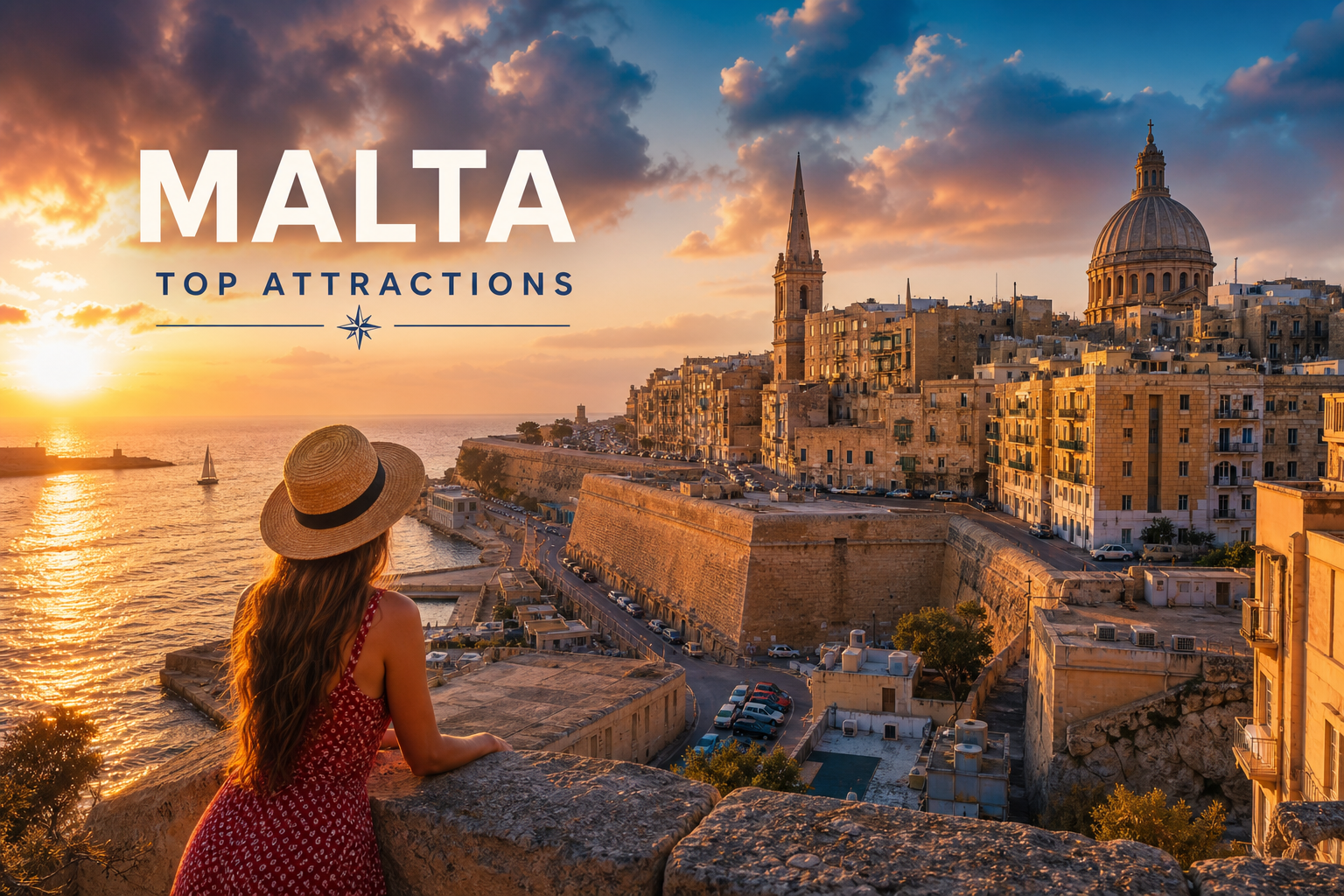
Valletta is one of the smallest capital cities in the world — just 0.55 square kilometres — but it is also one of the most densely rewarding. Built by the Knights of St John in the 16th century on a narrow peninsula between two natural harbours, the entire city is a UNESCO World Heritage Site. Honey-coloured limestone buildings line streets that drop steeply to the sea on both sides, baroque churches appear around every corner, and the Grand Harbour — one of the great views in the Mediterranean — is never more than a few minutes' walk away.
Whether you have a single day or a full week, this guide covers everything worth doing in Valletta: the essential sights, the underground history, the food, the evening scene, and a few things most guides overlook.
Getting to and Around Valletta
Valletta is easily reached by bus from anywhere on the main island — the central bus terminus is right outside the city gate. From Malta Airport, the X4 express takes around 30 minutes. Parking within the city walls is extremely limited; arriving by bus or on foot is strongly recommended.
The city itself is entirely walkable. Most streets are pedestrianised or too narrow for normal traffic, which makes exploring on foot not just pleasant but necessary. The main drag, Republic Street, runs the full length of the city from the main gate to Fort St Elmo. Almost everything worth seeing is within 10 minutes' walk of it.
Note for cruise passengers: Valletta is a regular stop on Mediterranean itineraries. The cruise terminal at the Valletta Waterfront is a short walk from the city gate. A full day is tight but manageable for the main highlights; prioritise St John's Co-Cathedral, the Upper Barrakka Gardens, and one underground attraction.
The Essential Sights
St John's Co-Cathedral
The single most important thing to see in Valletta, and one of the finest baroque interiors in Europe. The exterior gives almost nothing away — it looks like a plain fortress wall, which is essentially what it was designed to be. Stepping inside is one of those rare moments of genuine architectural surprise.
Built by the Knights between 1573 and 1578 as their place of communal worship, the interior was transformed in the 17th century into a riot of baroque ornamentation: gilded walls, carved stone floors made entirely of knights' memorial slabs, and eight richly decorated chapels each allocated to a different national group within the Order. The audio guide is excellent and essential for making sense of the detail.
The cathedral also houses two of Caravaggio's most celebrated paintings — including The Beheading of Saint John the Baptist, his only signed work and considered one of the greatest paintings of the 17th century. They are displayed in the Oratory adjacent to the main church.
Allow at least 1.5 hours. Book tickets in advance in peak season as queues can be significant. Shoulders must be covered to enter — scarves are available at the door if needed.
Upper Barrakka Gardens and the Saluting Battery
The Upper Barrakka Gardens sit on the southern bastions of Valletta, directly above the Grand Harbour, and offer one of the most photographed views in Malta: the three promontories of Vittoriosa, Senglea, and Cospicua (the Three Cities) jutting into the harbour below, with Fort St Angelo anchoring the scene.
Directly below the gardens is the Saluting Battery, where two cannons are fired ceremonially every day at noon and 4pm — a tradition dating back to the Knights. The firing is done properly, with full ceremony, and is worth timing your visit around. The battery itself (accessed by lift or stairs from the gardens) gives a closer view than the terrace above and is worth the small entry fee.
The gardens are free and open throughout the day. Arrive early morning for the best light and the fewest crowds.
The Lascaris War Rooms
Concealed 40 metres below the Upper Barrakka Gardens, the Lascaris War Rooms were the Allies' top-secret command headquarters during WWII and the nerve centre of Malta's defence during the Siege of Malta (1940–1942) — one of the most sustained aerial bombardments in history.
The complex has been meticulously restored to its wartime state, with map rooms, communications centres, and operations rooms all preserved as they were. Guided tours last around an hour and bring the history to life clearly — this is one of those attractions where the setting, underground in the actual tunnels, does a lot of the storytelling.
If you're choosing between the Lascaris War Rooms and the National War Museum at Fort St Elmo, most visitors find the War Rooms significantly more atmospheric and worthwhile. Entry is around €13, or €16 for a guided tour.
The Hypogeum of Ħal Saflieni
Technically located in Paola, a short bus ride from Valletta, the Hypogeum is worth including in any Valletta visit because it is the most extraordinary prehistoric site in Malta and one of the most remarkable in the world.
An underground complex carved from limestone between 4000 and 2500 BCE, the Hypogeum was used as both a sanctuary and a burial site — the remains of over 7,000 people were found within it. The rock-cut chambers descend three levels, and the acoustic properties of the deepest level are extraordinary: a single low note reverberates through the entire complex.
Entry is strictly limited to small guided groups, photography is not permitted, and tickets must be booked weeks in advance — sometimes months during peak season. Book as soon as your travel dates are confirmed. If you arrive without a booking, go directly to Fort St Elmo when it opens at 9am and ask about same-day or next-day availability.
Fort St Elmo and the Malta War Museum
At the very tip of the Valletta peninsula, Fort St Elmo has been at the centre of Maltese history since it was built in 1552. It held out against the Ottoman siege of 1565 until its garrison was entirely wiped out — an act of resistance that bought enough time for the Knights to hold Birgu and ultimately repel the invasion. The present structure incorporates both the Knights' era fortifications and later British modifications.
The Malta War Museum within the fort covers the WWII period with a solid collection of military hardware, uniforms, and documentary material, including the original George Cross awarded to the island of Malta by King George VI in 1942 — one of the most significant collective military honours ever awarded. The recently refurbished exhibits are clearer and more engaging than they used to be.
The Grand Master's Palace
The official seat of Malta's president and one of Valletta's most significant historic buildings, the Grand Master's Palace occupies an entire city block on Republic Street. The state apartments are richly decorated with frescoes, tapestries, and period furnishings reflecting the Knights' period of rule.
The Palace Armoury, housed in the former stables, contains one of the finest collections of arms and armour in Europe — over 5,000 pieces spanning the full period of the Knights' rule, including complete suits of armour, Ottoman weapons captured at the Great Siege, and elaborate ceremonial pieces. Entry is around €10. Allow 30–45 minutes.
Casa Rocca Piccola
A 16th-century palazzo still owned and lived in by the same aristocratic Maltese family — the de Piro family — for over 400 years. Guided tours take in a series of elegantly furnished rooms filled with antiques, family portraits, and memorabilia, giving a genuine sense of how Valletta's noble families lived through the centuries. The Marquis himself occasionally appears and talks with visitors.
There is also a B&B within the palazzo if you want to stay in one of the most atmospheric addresses in Valletta — guests receive a complimentary private tour.
Teatru Manoel
One of the oldest working theatres in Europe, Teatru Manoel was opened in 1731 by the Grand Master António Manoel de Vilhena and has been in continuous operation, with some interruptions, ever since. The baroque interior — intimate wooden boxes, painted ceiling, and a compact stage — is beautiful in its own right.
Guided tours run twice daily on weekdays (11am and 3pm) and cost €5. If the touring season aligns, catching a performance here is one of the more memorable things you can do in Valletta.
The Waterfront and the Harbour
Grand Harbour Boat Tour
Seeing Valletta and the Three Cities from the water transforms your understanding of how the whole system of fortifications works together. The scale of the harbour — the depth of the bastions, the relationship between Valletta and the cities opposite — is difficult to grasp from land alone.
Boat tours run hourly throughout the day from both the Valletta Waterfront and from Mġarr on the Three Cities side. Tours typically last 1–1.5 hours and are around €10–12 per person. If you want to stay in the Three Cities longer, hop-on-hop-off ferries run between Valletta, Vittoriosa, Senglea, and Cospicua throughout the day.
Food and Drink
Where to Eat
Valletta's restaurant scene runs from high-end fine dining to humble cafes. A few standouts:
Casual and Budget:
- Tal-Petut — tiny, proper local, minimal menu, excellent food
- U Bistrot — upscale casual bistro, Maltese and Mediterranean
- Pluck's Kitchen — whole-animal nose-to-tail cooking
- Any bakery for ftira sandwiches or pastizzi
Traditional Maltese:
- Ta' Kris (technically in Sliema, just outside Valletta) — rabbit stew
- Borg (nearby Rabat) — proper old-school Maltese kitchen
Fine Dining:
- Mdina Dine by Robert Busuttil — Michelin-starred, though technically in Mdina
- Zest Harbour House — upmarket seafood and Mediterranean in a waterfront setting
Most good restaurants require booking, particularly for dinner in peak season.
Strait Street and Friday Night Jazz
Strait Street (Triq ir-Republik) is Valletta's entertainment thoroughfare, lined with restaurants, bars, and clubs. On Friday nights, a handful of bars host live jazz and local bands — a genuinely good scene that brings both locals and visitors together. There's no entry charge, though you're expected to drink. Arrive after 10pm to catch the live music.
Evening Scene and After Dark
Valletta at night is a very different city from Valletta during the day. The daytime Valletta is stone buildings, museums, and tour groups. The evening Valletta is restaurants, bars, and locals out for the evening.
Strait Street is the centre of the evening scene — the area from Strait Street down to the waterfront fills with people from around 8pm onwards. The vibe is genuinely pleasant: mostly locals, a mix of ages and groups, good food and drink, and no sense of fake "tourism."
For something quieter, the Valletta Waterfront (across the water from the city proper) has restaurants and bars overlooking the harbour — beautiful at sunset.
Practical Essentials
Opening hours: Most museums open 9am–5pm. Some close Mondays. The Co-Cathedral and Teatru Manoel typically close on Sundays during services.
Getting tickets: The Malta Panoramic Pass includes entry to several museums and major sites and can work out cheaper than buying individual tickets. However, book the Hypogeum separately in advance regardless of the pass.
Photography: Some museums and sites (St John's Co-Cathedral, the Co-Cathedral Museum, the Hypogeum) restrict or prohibit photography. Respect the rules.
Weather: Valletta is fully exposed to the sun in summer and can get extremely hot. Morning visits are more comfortable than afternoon ones.
Comfort: Valletta is built on hills and involves a lot of walking on uneven stone steps. Comfortable walking shoes are non-negotiable.
A Sample Itinerary
One day in Valletta (cruise passengers):
- Arrive by shuttle from the cruise terminal
- Walk directly to Upper Barrakka Gardens (free, best views)
- Visit St John's Co-Cathedral (1.5 hours including queue)
- Lunch on Strait Street
- Visit the Lascaris War Rooms (1 hour)
- Return to ship via the waterfront
Two days in Valletta:
- Day 1: Co-Cathedral, Upper Barrakka, Saluting Battery, Lascaris War Rooms
- Day 2: Fort St Elmo, Palace Armoury, Casa Rocca Piccola, evening on Strait Street
Three or more days:
- Add the Hypogeum (book in advance)
- Day trip to Mdina or the Three Cities
- Relax and eat better, rushing less
Final Notes
Valletta is dense with history and genuinely interesting, but it's also very manageable in scale. A one-day visit can cover the key sights; a three-day visit allows you to breathe, eat well, and develop a feel for how the city actually works beyond the tourist trail.
The single mistake most visitors make is visiting Valletta only as a tick-box exercise: St John's Co-Cathedral, Upper Barrakka Gardens, done. It deserves more than that. Sit in a café on Republic Street for an hour. Wander the side streets. Eat properly. Valletta reveals itself to those who slow down.