What Language Do They Speak in Malta? Official Guide 2026
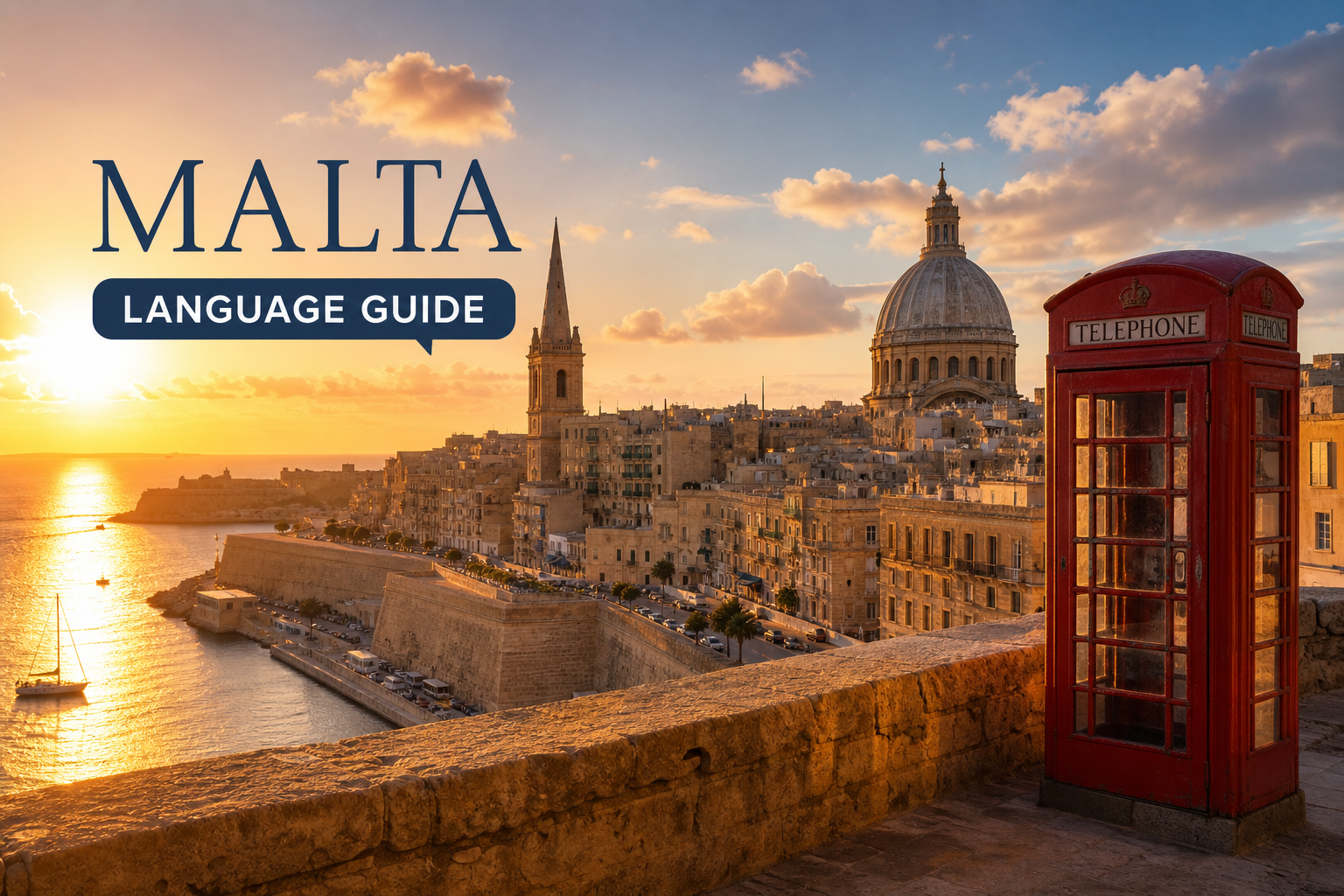
Malta has two official spoken languages: Maltese and English. Add Maltese Sign Language, and you have three official languages on an island that covers roughly 316 square kilometres, smaller than many cities. For somewhere this compact, the language situation in Malta is genuinely layered, shaped by centuries of conquest, trade, and colonial rule.
If you're planning a trip, English is more than enough for most visitors. For routine tasks like ordering coffee or handling government paperwork, English works without issue, though a few words of Maltese are always appreciated. But that simple reassurance misses most of the story. Understanding how language actually works in Malta tells you something real about the place: its history, its identity, and what daily life looks and sounds like for the people who live there.
This guide covers the official status of each language, the origins of Maltese, who speaks what and how well, Italian's unofficial but persistent presence, and what any of this actually means if you're visiting or settling here.
Languages in Malta: official status and how they work in practice
Three languages hold official status in Malta: Maltese, English, and Maltese Sign Language. Of the three, Maltese carries the additional title of national language. That distinction has a practical consequence: when laws are enacted in both Maltese and English and the two versions contradict each other, the Maltese version takes legal precedence. That's written into the constitution, and it matters.
How Maltese and English split the workload
Government operates fully in both languages. Laws are published in both. Courts use both. Public signage, official documents, and administrative communications generally appear in both, in line with Malta's constitutional language policy. English became an official language when Malta gained independence on September 21, 1964, though its role in public life stretches back much further through British colonial rule. For visitors and expats, this means virtually every public service, from registering for healthcare to handling residency paperwork, runs in English without any need for a translator.
What happens in education
Primary school is taught largely in Maltese. Secondary and tertiary education shifts almost entirely to English. The practical result is a population that isn't just bilingual in theory but genuinely functional in both languages from an early age. French, German, Arabic, Russian, and Spanish are available as electives at higher levels, but English is the academic default by the time students sit for university.
Where the Maltese language actually comes from
Here's the detail that makes linguists genuinely interested in Malta: Maltese is the only Semitic language in the world written in the Latin alphabet. That single fact summarizes centuries of history in one sentence.
Arabic roots and the island's medieval past
Maltese evolved from an Arabic dialect, specifically one tied to the Arabic-speaking Muslims who colonized Malta beginning around 1048 CE. The core grammar and a substantial portion of the original vocabulary are Semitic in structure, closely related to the western Arabic dialects of Algeria and Tunisia. The island had sat largely uninhabited for nearly two centuries before that colonization, which meant the incoming language took root without competing with a strong existing vernacular.
How Sicilian, Italian, and English got layered into the language in Malta
Norman settlement from the 13th century brought Sicilian and later Italian influence so deeply into the vocabulary that the language became genuinely hybrid. Romance words became embedded at a structural level, not just borrowed as loanwords. By the late sixteenth century, the influence was phonological as well, with non-native speakers of Sicilian and Italian shaping how Maltese sounds were produced. English arrived through British colonial rule and took hold in modern everyday speech. In 1924, Malta standardized its orthography using a modified Latin alphabet designed to represent both the Semitic phonetics and the heavy Romance vocabulary. The result is a language that belongs to no neat category, and as linguists have noted, it remains the only Semitic language written in Latin script with such a deep Romance substrate. Nothing else in Europe quite resembles it.
Who speaks what in Malta today, and how well
The numbers here are worth quoting directly rather than paraphrasing into vagueness. According to the 2023 Malta Skills Survey, 96% of people living in Malta understand English. Maltese comprehension sits at 90.4%. These are not figures about Maltese nationals specifically; they cover everyone living on the island, including a substantial non-Maltese resident population. (The full dataset is published by the relevant Maltese government authority and should be consulted for methodology.)
The proficiency picture for Maltese and English
Understanding a language and being proficient in it are different things. For Maltese, advanced speaking ability is reported by 81.3% of residents, while advanced writing proficiency drops to 59.1%. That gap reflects how language use in Malta actually works: spoken at home, heard on the street, but less formally practiced on paper. English proficiency is high across the board, with over 60% reporting advanced-level skills in listening, reading, speaking, and writing. Younger generations report stronger advanced English than older groups, which tracks with a school system that conducts most serious academic work in English.
What the census shows about daily language use
Comprehension statistics and daily language use tell different stories. The 2021 Census recorded primary spoken language across the population: Maltese is the main spoken language for 70.86% of residents, English for 10.10%, and Italian for 2.69%. Read those two datasets together and you get an accurate picture: nearly everyone understands English, but Maltese is the language of home and daily life for the majority of people actually living here.
Italian in Malta: not official, but hard to avoid
Italian has no official status in Malta. It was stripped of that status in 1934, partly due to the political tensions of the era, specifically British efforts to counter Mussolini's claims that Malta was unredeemed Italian territory. Yet if you spend time on the island, you will hear Italian, see it on menus, and find that a substantial number of people understand it at least partially. That's not a coincidence.
How Italian television shaped a generation
From the 1970s onward, Maltese households could receive Italian television broadcasts. Italian channels brought soap operas, news programmes, and entertainment into living rooms every evening. Comprehension grew from roughly 15% in 1950 to estimates of around 86% at some level of understanding by 2010. This was passive language acquisition at scale, driven by decades of broadcast media rather than classroom instruction.
Where Italian shows up today and whether it's fading
Older generations carry higher Italian comprehension. It remains common in certain professional workplaces and appears in cultural contexts. But younger Maltese are growing up with English-language media and streaming platforms, not Italian state television. Active Italian use is trending downward even as the historical foundation remains. Italian once ranked as the top elective foreign language in Maltese schools; it still has a presence, but the numbers choosing it have declined. The comprehension is there, particularly among older residents; the active use is shrinking.
Maltese Sign Language: officially recognized and still evolving
Maltese Sign Language, known as LSM, became an official language of Malta on March 16, 2016, through the Maltese Sign Language Recognition Act. Parliament passed it unanimously. The legislation established the Sign Language Council to promote LSM, maintain a register of qualified interpreters, and advocate for the Deaf community across healthcare, education, and public services.
The gap between recognition and reality
Legal recognition is meaningful, but it doesn't close a service gap overnight. In 2014, Malta had four qualified LSM interpreters for the entire island. By 2018, that number had grown to eight: five employed through an agency, three working as freelancers. The University of Malta launched a postgraduate LSM Interpretation programme in 2018 and graduated its first class in 2021. The infrastructure is being built, but the Deaf community continues to push for wider availability across the services that matter most: hospitals, courts, government offices, and schools. Progress is real, but it is also gradual.
What this means if you're visiting or moving to Malta
The practical bottom line for English speakers: you will get by in Malta without friction. Shops, restaurants, hospitals, government offices, and schools all function fully in English. Nothing about daily life in Malta requires you to speak Maltese to get things done. That's genuinely true, not a qualified reassurance.
A few Maltese phrases worth knowing
That said, making zero effort with the local language is a choice, not a necessity. A handful of phrases land well with locals:
- Bonġu (bon-ju): good morning
- Saħħa (sah-ha): goodbye, or cheers
- Grazzi (grat-see): thank you
- Jekk jogħġbok (yek yoh-jbok): please
- Mela: a conversational filler meaning roughly "so" or "right," used constantly by locals
Your pronunciation doesn't need to be perfect. Even a basic "Grazzi" at the end of a transaction shifts the register of the interaction, most travellers find that a small effort with local phrases is well received.
Getting settled beyond just the language
For anyone relocating rather than visiting, language is one piece of a larger puzzle. Navigating residency requirements, understanding public services, finding reliable local information, and building a routine in a new country takes more than knowing how to say thank you. Practical guides covering exactly that process, from paperwork to finding your feet, can make the difference between a smooth transition and an unnecessarily frustrating one.
The real picture of language in Malta
Language in Malta works, in practice, as two languages running in parallel. Maltese is what most people actually speak at home, shaped by Arabic roots, enriched by centuries of Mediterranean contact, and still very much alive in daily life for the majority of residents. English is the practical backbone, present in law, education, and business. Italian lingers in the background, especially among older generations and in cultural contexts, its presence more historical than active. Maltese Sign Language is gaining ground through official recognition and slowly growing infrastructure.
If you're visiting, English is genuinely sufficient. If you're staying, learning even the basics of Maltese opens doors that tourists never reach. Locals appreciate it. More than that, the language itself is worth knowing, because understanding how Maltese sounds and where it comes from tells you more about Malta's history than any guidebook summary.
Languages in Malta reflect the island's past directly: layered by conquest, trade, and colonial rule over a thousand years, and more interesting the closer you look. That's worth understanding before you arrive, and worth exploring further once you do.